

CT Scan vs MRI: What’s the Difference and Which Test Is Right for You?
A CT scan and an MRI are both imaging tests that help doctors look inside the body. They are not interchangeable: each uses different technology and may be more suitable for different medical concerns.
The right test depends on your symptoms, the body part being examined, your medical history, and your doctor’s clinical assessment.
CT Scan vs MRI: At a Glance
| Feature | CT Scan | MRI |
|---|---|---|
| How it works | Uses X-rays and computer processing | Uses a strong magnetic field, radio waves, and computer processing |
| Radiation | Uses ionising radiation | Does not use ionising radiation |
| Scan time | Usually faster | Usually takes longer |
| Often useful for | Emergency injuries, bones, lungs, some abdominal conditions, and blood vessels | Brain, spine, joints, muscles, ligaments, nerves, and many soft-tissue conditions |
| Noise / space | Usually quicker and more open | Can be noisy and feel enclosed for some patients |
| Contrast | May use iodine-based contrast | May use gadolinium-based contrast |
What Is a CT Scan?
A CT (Computed Tomography) scan uses X-rays to create detailed cross-sectional images of the body. It can provide more detail than a standard X-ray and is often used when quick imaging is needed.
A CT scan may be considered for conditions such as:
✅ Head or chest injuries
✅ Bone fractures
✅ Lung conditions
✅ Abdominal pain
✅ Kidney stones
✅ Certain blood-vessel concerns
What Is an MRI?
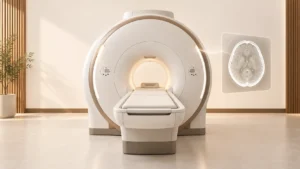
An MRI (Magnetic Resonance Imaging) scan uses a powerful magnetic field and radio waves to create detailed images. It does not use ionising radiation.
An MRI may be considered when doctors need detailed views of soft tissues, including:
✅ Brain and spinal conditions
✅ Joint, ligament, tendon, or muscle injuries
✅ Nerve-related concerns
✅ Some heart, liver, pelvic, or abdominal conditions
✅ Certain tumours or inflammation
Which Test Is Better: CT or MRI?
Neither test is “better” in every situation.
A CT scan may be preferred when fast imaging is important or when examining bones, lungs, trauma, or certain emergency conditions. An MRI may be preferred when detailed soft-tissue images are needed, such as for the brain, spine, nerves, joints, or muscles.
Your doctor will recommend the test that is most appropriate for your symptoms and medical condition.
Is CT Scan Radiation Safe?
CT scans use ionising radiation. When a CT scan is medically needed, the expected diagnostic benefit generally outweighs the potential radiation risk. The imaging team uses the appropriate scan protocol for the clinical requirement.
Tell your doctor or radiology team if you are pregnant, think you may be pregnant, or have had multiple imaging tests recently.
Do CT Scan and MRI Need Contrast?
Not every CT scan or MRI requires contrast.
Contrast may be used to make blood vessels, organs, inflammation, or certain abnormalities easier to see. Tell the radiology team if you have:
✅ Previous contrast reactions
✅ Kidney disease
✅ Pregnancy or possible pregnancy
✅ Asthma or significant allergies
✅ Any implanted device, metal fragment, or prior surgery
How Should You Prepare?
Preparation depends on the body part being examined and whether contrast is required.
Before your scan:
✅ Carry your doctor’s prescription and previous reports
✅ Follow fasting instructions if provided
✅ Inform the team about medicines, allergies, kidney problems, pregnancy, or implants
✅ Remove jewellery, watches, and other metal items before an MRI
✅ Ask the radiology team if you have claustrophobia or anxiety about the scan
When Should You Contact a Doctor Urgently?
Seek urgent medical care for severe or worsening symptoms such as sudden weakness, difficulty speaking, severe headache, chest pain, major injury, breathing difficulty, or loss of consciousness.
Emergency warning: For a medical emergency, call 108 or 112, or visit the nearest emergency department.
FAQs
Is an MRI safer than a CT scan?
MRI does not use ionising radiation, while CT uses X-rays. However, the most appropriate and safe test depends on the clinical situation, the body part being examined, and your medical history.
Is CT scan faster than MRI?
CT scans are often completed more quickly than MRI scans. Actual scan time varies by the body part, whether contrast is used, and the clinical requirement.
Can I have an MRI if I have an implant?
Some implants are MRI-safe, while others need special assessment. Always tell the radiology team about pacemakers, cochlear implants, clips, metal fragments, joint replacements, or any previous surgery.
Can I eat before a CT scan or MRI?
Some scans require fasting, especially when contrast is used or when certain abdominal areas are examined. Follow the instructions given by your healthcare team.
CT and MRI Services at Backbone Medicity Hospital, Rajkot
For guidance on the appropriate imaging test, consult your doctor or visit the Radiology Department at Backbone Medicity Hospital.
Book an appointment for consultation or imaging guidance.
Key Takeaways
Core Symptoms
- Chest pain and discomfort
- Shortness of breath
- Fatigue and dizziness
- Irregular heartbeat
Prevention Tips
- Regular exercise and healthy diet
- Avoid smoking and limit alcohol
- Manage stress and blood pressure
- Regular health check-ups
Important Facts
- Heart disease causes 1 in 4 deaths
- 80% of heart diseases are preventable
- Over 17 million deaths annually
- Early detection saves lives
Related Articles


Your Health Journey Starts Here
Our team of specialists is dedicated to providing personalized care tailored to your unique needs. Schedule a consultation today and take the first step toward better health.